
News 2012
News 2010
News 2009
News 2007
News 2006
News 2005
News 2004
There was a contretemps at The Brighton during the last poetry reading before Xmas. I'm working on some reportage of the event, and a poem which I'll read at the next get-together. Both are available in the "Vindictive Advice" section of the site.
If you know the names of any of the people mentioned in the report that are currently unnamed, or have additional information to add as an eye-witness, please contact me.
12/20/06
By Gregg Glory [Gregg G. Brown]
After Note
Dear All:
This November, I participated in National Novel Writing Month, started by nanowrimo.org. The goal was to write a 50,000 word novel by the end of November, having started on November 1st. I wound up writing a 64,000 word first draft of a children's novel titled "The Singing Well" in eighteen days. This averages out to some 3500 words penned per day. This means that my novel is not three times worse than a Hemingway novel, but seven times worse.
I pursued the NaNo nonsense pretty restlessly the last three weeks. I woke and wrote at 5 AM every day, and even drank less. The infernal NaNo backwards clock got into my head. I felt as if each second were being tattooed on my skin, erased, and then tattooed again with the new time--one second less than I'd just had to accomplish the task! I guess I'll write one hell of a sloppy memoir on my deathbed if this is any indication.
Some of the remarkable things I noticed during this process were that my writing style changed considerably. Changed even from what I thought I would write, or would be able to write when pouring through a story at top speed. What I thought I'd be doing, since I am a poet and the story involves a good deal of singing and spell-recitation, was writing poems and witchy rhymes for the characters to use to change their reality. Most of my other prose work has some form of elaborate meditation on inner states, or ornate remembrances. So, I thought I'd have vast descriptive passages punctuated by snippets of limericks, etc. What came out instead was a fast-paced, character and adventure-filled narrative. I found myself chasing after the story, putting down only the minimal notations to forward the action. Shock! "The Singing Well" was not merely magical in its proposed subject matter, but magical in its effect as well.
Perhaps the most interesting thing of all is the love story that occurred. During the writing of this novel, I fell in love with a fourteen year old girl. Her name is Sarah, and she's the heroine of "The Singing Well." Her grit, her fidgety aloofness, her disdain and self-doubt all brought me up into her difficulties and sorrows. Whether these fibrillations are ultimately redemptive or damning, the reader must tell.
The entire production, first draft foibles and all is available online here: http://www.gregglory.com/singingwell/. Personally, I recommend waiting until the draft has at least been gone through once entirely for typos and simple grammar errors. Check back in December.
Happy holidays!
Sincerely, Gregg
FIRST DRAFT Completed between NOV 1st and 18th, 2006
    CHAPTERS  [Return to the home page to open the next chapter]

    00 "Introduction"
    01 "Off Key with the Choir"
    02 "Whispers in the Well"
    03 "Land's End"
    04 "The Devil You Say"
    05 "Paper Boats"
    06 "Fight at the Mickleswift"
    07 "Big! Wind!"
    08 "Noises Off"
    09 "The Gods of Autumn"
    10 "A Long Talk at the Table"
    11 "Further In"
    12 "When the Moon Melts"
    13 "Underneath"
    14 "Dinner with a Daggonnath"
    15 "A Shadow on the Wall"
    16 "Shadows Three"
    17 "A Shadow on the Moon"
    18 "We Have Your Children"
    19 "A Dare, A Bet, A Debt"
    20 "The Well Becomes a Window"
    21 "Battling the Wind"
    22 "A Glimmer in the Stream"
    23 "Sarah, Darling"
    24 "The Neighbors' Walpurgisnacht"
    25 "A Feast of the Gods"
    26 "A Giant Surprise"
    27 "A Turn for the Worse"
    28 "Voices and Choices"
    29 "The Rats Help Out"
    30 "An Underground River"
    31 "The River of Time is Stopped"
    32 "Finally!"

    Complete Text
    Complete Word Doc
    BUY a paperback copy
Accompanying photos can be found in my London Trip, 2006 photo gallery. Immeadiately below is my description of my London Essay project, currently under way.
Slim reflections on a pilgrimage to London and Stratford-Upon-Avon
"No bird so wild but has its quiet nest" -- P. B. Shelley
by Gregg Glory
Freshly returned from London, and I feel clotted with the creme de la creme of the experiences, sights, and histories there. I look forward to giving fictitious, but accurate, reports of my sojourn very soon. But for now, I'll simply leave you with a quote from the BBC News caster, who turned to her colleague during the A.M. news and said "It's official Paul, this has been the wettest May ever."
re-written in tranquility
These notes occurred in a hurry, but will be re-written in tranquility. I'm home with a negligible tally of booty, and two moleskin notebooks rather stuffed with nonsense. This is what I have to shift about and share with you. You are welcome to peruse and enjoy, just as I have felt welcomed and allowed in London, with never a shyness put in the way of my curious eyes.
What my memories are, I must decide. I have in hand an itinerary outlined by Carlo and myself on the train back from Stratford, but the subjective substance of my days away must be sorted, aborted, or saved, by myself alone. A tour guide who had lived away from England swore she had missed the rain as she dodged drops trickling into the red bus. And I don't think I'll have as harsh a response to the rain when it comes my way again; when the sky broods, so shall I. Some portion of my substance has always been submersible, and now my spirit has a pair of paddles as well it seems.
The local culture of incapacity.
This old world's in a whack of a mess. Well, it always has been, hasn't it? But I want my friends and my neighbors and my country to prosper. I want us to be prepared for the new things coming down the pike--to be able and responsive if not out-right positively in-charge.
Heard a saddish story last night that made me feel a bit more blue about it all--and my response is to tap out this tale, and to re-dedicate myself to creating an imperishable culture of seductively virtuous beauty based on the individual. Here's the story: a local Italian ices spot, Strollo's Lighthouse in Red Bank, changed their Sky Blue flavor to Blue Raspberry to help people know what flavor they are eating. Customers weren't willing to pay 70 cents for the sky. It seems to me that this is a symptom of the death of the imagination, and that these folks are now getting what they deserve: no longer can they lick the skies, eat the clouds, or taste very heaven: instead their tongues are stuck on a prickery bush. And however delish that dish is, it is definitely less inspiring.
8/04/2006
Induced musings on the coo and call (and backslap) of the creative process. Blame NJCreative for my thinking about this.
When pursuing a goal or inspired to begin a project, the feeling of pursuit is manifest, strong, and lovely. As if to catch the very air we run and scamper over the impeding rocks, unheedful of their danger. Success and adventure follow our unwearied steps. Songs lift from our labor as from the cricket's legs, the natural and high accompaniment of action.
Success and adventure follow our unwearied steps
Once well-in to the project, with either an end in sight, or the continuance of the chase yielding only more of the same, and not better or other,--not, certainly, anything new. Really delightfully, damnably new. Not the happy accidents of the first scamper, but the predicable results of knowing application. But one goes on because the project is incomplete without further results, and a sense of obligation arises. I shall spend so many minutes per on this project to see it to completion. Then the song huffs out of the accordion, and you're only left with the effortful pumping. You sell your guitar and you seek a new medium, fresh rocks, unclimbed hillocks and a dawn that does not so damnably always arise in the East.
What can transform this dull pile of stuff in your heart back to the glitter of its original gold? Where is the shine that first called you from your nest? Where's the fiddle that makes the dancers clap and thighs thump to the bump and the beat? Oh, yes, it's certainly somewhere. But where oh where, and how do I dare to find this time what was given times out of mind? How release the slap of happiness from the grip of obligation?
Well, I don't know how exactly, and I certainly don't know why, but love's the stuff that makes the obligation light, and keeps the work weighted with meaning which otherwise would pall. Then there's the joy of pure service rather than the ego of going, the I of accomplishment. The good things in the doing reassert themselves, and the experience returns to its open components, the hippy constituents of which it is knitted, and is not so knotted to the goal you've imposed. And yet the goal remains, and is not diminished. It simply shares the space of active doing with the humble propeller love provides.
So, fall in love with yourself, and in love with your whimsy which prompted the project first. Serve the girl who kissed you before she knew your name.
7/14/2006
Tribute show for the late lamented writer Chris Barry at The Saint in Asbury Park
Chris Barry was a man of words. In many ways, he was a man made of words. In his headlong, lusterless Lester Bangs way, he played a kind of broken jazz with his run-on observations and digressions. But he never stopped talking, and he played his broken jazz in a way that only he could--and a way that no one else would ever dare. I knew everyone would have stories and memories of this guy who we all knew as a ceaseless commentator--a commentator who drew you up into his dream of rock music. Chris was a kind of evangelist for the individual, and I couldn't wait to hear what all these other individuals had taken away from knowing Chris.
In many ways, he was a man made of words
Chris Barry was a montrous, fire-breathing, curly-headed Puff the Magic Dragon. He was always the endless voice and advocate of peace. If you punks out there weren't feeling particularly peaceful, he'd offer you a toke to take away your edge.
Everyone came in their long suits and happy faces. After all, this was a rock and roll show. Dark Heart played, and really wailed some punky tunes. There was a display on a table of some snaps of Chris, and bits of stuff from his life. His cousin was there. Everyone I talked to missed him, and seemed to want to share something. That was made difficult by the sound level, which put each mourner in a bubble of noise. But it was made impossible by the noisome nonsense of Al "Museless" Muzer.
Al Museless ranted and chanted on as MC for the evening--trying to drum up donations for the "fight against cancer." That's all well and good I suppose. The money was being collected in the red panties of a headless manikin, and Al kept urging the audience to "stick it in there." In between bands he would drivel on, sticking the microphone into the faces of a few of his musician buddies and making vacant observations on Chris' life. "Chris got a lot of bands their first review. Whatever that's good for." The musicians all played off of Museless' inanity, and kept their remarks terse. "Chris is dead. I'll miss him, I guess."
The one individual we got to hear from was Lazlo from BlowUpRadio.com, and that was only because he was sick, couldn't attend, and had sent Museless an email with a story about Chris Barry. Introducing the email, Museless remarked that "All annunciation errors are brought to you by Jaegermeister." He then proceeded to mangle the email, which told of Lazlo's gratitude that Chris gave him his first poetry-reading gig, and then quoted a note he had gotten from Chris Barry about the sudden demise of the Broadway Central Cafe.
a much-beloved icon of the South Amboy scene
And that's what I missed hearing last night--everyone's two cents' worth. And that's Al Museless' fault. He was a rotten MC, and a bad friend to Chris now that Chris is dead.
Museless then proceeds to analyze Lazlo's note, saying, "Whatever that means. I don't know why Lays-low included that letter. Doesn't make any sense. Oh well, whatever. Stick some money in the dummy."
"Because Broadway Central and Chris Barry both left us suddenly, without warning, and now we are left grieving. You moron. Duh."
"Oh, yeah. Yeah. That makes sense. I never was any good at guessing the answers on Jeopardy."
"They give you the answers on Jeopardy. All you need is the right question."
The only offensive thing about Chris was his breath. The same breath he filled with a million words a day. Sad to say, that breath, and those words were stopped some weeks ago. Chris Barry's probably penned a review about you, about your band, elevating his crazy Lester Bangs jabber into a kind of stoked poetry. And he wore the poet's cap as well, the mad hat of poetry.
Chris has stopped talking now, so let's dig up his articles and poems and give them the once over. At least those old words can keep on talking to us.
6/12/2006
Chris Barry, Asbury Park Poet and Mad Hatter Dead at 54
J Keef Christian just called to let me know that Chris Barry, poet and longtime New Jersey music journalist, died last week. His only close relative, his brother, lives in Mexico, so it will be difficult to figure out what will be happening with Chris' writing etc. I volunteered to do what I could, and am reproducing the note I just sent to J Keef in case anyone with more information stumbles across it through a search engine. Please contact me if I can be of any assistance. I don't know what else to do. Presumably there will be an Asbury Park memorial show at The Saint or The Stone Pony sometime this summer.
Dear J Keef:

Brighton Poesy Show:
Wed May 24
'Maybe I Will'
Poetry Show
Sign up for Jacko's email list. There's a copy below of the most recent, which includes the poetry show noted above. I'll be in London kissing the dust of those poets who have gone before.
It was terrible to hear that the Mad Hatter himself has passed through the pearly gates. Chris Barry's name will echo awhile here below--just as his words always did. Please let me know of anything I can do to help caretake his literary legacy. I can scan documents, make electronic copies, store things on the web, etc. quite easily and will gladly take on any such task--including arranging storage space for any of his materials that have survived him. Silence was never his long suit in life, and in death it is an unseemly garment for a poet.
Sincerely,
Gregg
______________________________________________
Gregg G. Brown
324B Matawan Avenue
Cliffwood, NJ 07721
(732) 970-8409
gregglory.com
______________________________________________
5/16/2006
Juvenile outpouring of a punk late-bloomer to be readied for the proscenium's guillotine

"It's the Sex Pistols!!!", Gregg Glory's first verse play, will be debuting at the Labour Club in Northampton, England (directions). Billed as "a play for audience participation," Glory is coming off a brilliant reading at the Word Fest 2006 in Metuchen, NJ. At least, that's what he's telling all of his friends who'll listen. Never interviewed concerning the origin or inspiration of the piece, Glory has nevertheless held forth on the topic of his midnight-to-three a.m. shift as a DJ at his alma mater's radio station "back in the day," saying how he used to love playing punk albumsides uninterrupted and then read a scene from Shakespeare aloud to the dreaming audience. This was known informally around the campus as "Tea Time with Gregg G. Brown."
	Sunday, May 21st, 2006, 8PM
	Northampton Labour Club
	97 Charles St,
	Northampton, NN1 3BG,
	United Kingdom
	01604 454280
The play was originally published by BLAST PRESS eons ago, and was a wall-eyed view of a moment of cultural history even back then. But, since history is a fiction that no number of half-and-halfs can erase, such vivid fictionalizing simply seems to be in the normal course of events. A sign of life itself, as it were. The play was collected into Glory's verse play doorstop book just three years ago, titled "A Million Shakespeares (737 pp)." It is available to read online here.
From the Prologue:

	Everything not incidental
	To a prince's birth in loathed ashes
	Shall be told in what we are about to speak:
	Mire costuming here a spirit as rare
	As any that went naked in greater ages
	Whose philosophers, incidents, and strange tales
	Whisper still in books passed down to us.
UPDATE: Gig cancelled because I got sick on a beer-run the night before without my coat.
5/10/2006
Occassional essays and digressions surging up from the source.
I'm tempted to say that this prospective collection of thoughts and scribbles will veer from the ridiculous to the more ridiculous. But that would be a slur on the creator, and so I shall refrain from such malignity. Often, very often, I've been told that I over-introduce my tropical topics with a blizzard of disguising digressions. I'm informed variously that this is helpful, too helpful, not helpful at all, and by Jacko Monahan to "just shut up and read da po-EM."
Inexpicibly, I'm collecting these various thought-episodes into a short prose collection of essays and introductions (and, here and there, a stray letter let loose in the direction of an attentive ear). One feels that these tidbits and tiddlywinks must fare better on their own then when attached like an irreverent dingy to the majesterial ship of a book of poems. Much can already be spotted or skimmed from this website and the various collections from which these words were originally taken. I will be dusting them off and re-writing them for the sake of coherency and tang. What was only hinted at before in the emergent wood of a metaphor shall now be hunted down and turned to trophies.
Partial Contents list:
4/6/2006
Buy Floaters ($11.95 pap. 136pp.)
Floaters, Brandi Scollins-Mantha's second novel, is now available as a BLAST PRESS / iUniverse paperback. Check it out on the link above, or read a sample of the novel on iUniverse's website here.
Floaters captures one woman in the in-between space of life where you must decide if you are going to bail or jump ship.
Find out more about Floaters at gregglory.com/floaters.
Book Description
Working as the assistant to the girl you hated in high school, finding your husbands dirty laundry behind the entertainment center, discovering that your life may need a few changes--Floaters, the new BLAST PRESS novel by Brandi Scollins-Mantha, author of My Intended,
Liz Welkirk realizes that something is just not right
Praise for Brandi Scollins-Manthas first novel, My Intended:
"Beautiful imagery and eccentric secondary characters greatly enhance this unusual story." --Booklist
"An odd first effort, secretly a love story, sweetened by its understated melancholy." --Kirkus Reviews
3/20/2006
[15 Years of Alice B. Talkless]
Civilization herself could be considered a conspiracy. A conspiracy to recall our history, to keep us from making the same mistakes. All of civilization could, in this way, be considered a giant guilt-trip. From this weight, this burden of too great remembrance, too infinite recall that puts our every erratic action in quelling context, Alice B. Talkless offers no escape.
Their language is all the stuff of contemporary activity punctured by the knelling bell of recall. No deed of bravado or bald assertion occurs but that its opposite is limned by a phrase or implied by a wry title. I think of "Nicole Smith Addresses the Jury," which calls to witness the very aggrieved ghost of all history, the executed victim, and refuses to let the verdict of the newspapers stand untarnished by rueful doubt.
Civilization herself could be considered a conspiracy
A rebellion of consciousness must insert a distance between the perceiver and its object for the sake of imposing an aesthetic shape upon all that occurs in the "performance space." It asserts both that "I know what it is," and "It is not what it is" at once. The dissonance of this assertion invokes a true tension in the audience that only a cogitation resembling meditation can resolve. And in punk, as in the whippet-wild customs of the fervid dervish, meditation must take place in the horrid whirlpool of a too-tempestuous activity, a storm of limbs and lights and outrè images for the sight.
The thoughts of one's own mind become the only rock for setting forth, for all else is blaze and mayhem. And the description for such self-centering activity in a situation of sensory overload has always been grace. Punk evokes grace from those who grapple with it. In the heat of the wrestling match, it is the coolest strategist who prevails, often by less than the advantage of an inch in the swale of sweats.
Down the long bowling alley of the past, a face comes hurtling: Scott Stamper, proprietor of a small rock club bunched in-between two abandoned businesses in the rotted-out Asbury Park of the early 90s. His hair was Hitler-dark, and his eyes a damaged periwinkle blue. At the time, I had been running a raggedy poetry reading betwixt rock acts on the long side-stage of the joint, where the black bar leaned toward the golden rail of the stage from no more than four feet away. The Thunderbird Cafe had that waxy look of a retired stripper stuck attending a laundromat to keep her ten cats in kitty litter.
"Hey there, Gregg. There's gonna be a good act in here next week. Something you would like. A kind of punk performance art thing. Two sisters, a little weird. You'll like it."
Seven nights later, behind the gilded bar of the stage, with much wailing and gnashing of teeth, with only a bass guitar and two querulous voices, Alice B. Talkless took the world to task with all the brazen bravery of any saint. Cheerleaders' struts and call-and-response echoes rocked the badinage between two sisters whose minds had the wired intimacy of a single soul. Their get-ups were Alice in Wonderland meets Bo-Peep -- at the sex shop. The strength and strangeness of their voices registered from a land beyond, as though one overheard the thoughts of a mountain at its own birth. Shepardesses of a herd that didn't know it was lost, they sang for their sheep.
	I'm stitched in the rain
	stretched from a hangin' twine
	pink plastic coat without my feet
	crawlin' as the night jumps
	from maggoty sheep
One of the sisters is wideeyed and broadbrowed. Her operatic voice curls alluringly, alarmingly around the nonsense syllables. She plays a funky-chicken bass that keeps the heady abstractions of patriarchy and personal values on track. Amy Mayhem by name, and she keeps up with her moniker.
"What you won't risk is not what you value," says Alice.
Once, with her voice on dire fire before the raw stop of a brick wall at some dump in hypocritical Red Bank, all of her soaring moral imperatives scanned the room like Zeus' lightning and left no exit. All the space between performer and feted evaporated and we were stuck and paired in the brick nothingness of the sonic moment. An instant empathy, so vast and relentless as to leave room only for nausea in the rigid psyche, was forced on all in the room; a miracle in that vain and vapid town.
Both the sisters are long with "stupid, straw-pale locks" that belie the tailor-fit, arrowy troubles or their female status. They play a three-card monte with words and sounds, and they use the apparentness of their commitment to being time-bound and female as just another card in the torrid shuffle. Self-aware as a surgeon equipped with a mirror, they keep themselves from developing the cancerous egos of other bands by excerpting the lump with a deft twist of the wrist.
my eyes turn inward at their approach
4/1/2006
A speech for national poetry month about BLAST PRESS.
by Gregg Glory
Come see and hear a special day of poetry and jazz at Flushing Town Hall on April 8th, 2006.
Flushing Town Hall
137-35 Northern Boulevard
Flushing, NY 11354.
Take the 7-train to Main Street, Flushing. We are one block east of Main Street, at the corner of Linden Place and Northern Boulevard.
Ab li dolen in l'air [look up: beauty falls from the air]
"A book should be a ball of light in your hands." -- Ezra Pound
 As we all know, April is "International Guitar Month." But my heart twangs for poetry, and I was invited here to tell you a little bit about a tiny poetry publishing company called BLAST PRESS.
Let's start with what BLAST PRESS is not. BLAST PRESS is not a community. It is not a community-building venture. It is not by, about, or for "the people." Unlike the pretentious anthologies that weigh down the shelves and slander the individual by gluing him into some historian's scripted story, BLAST PRESS is not a collection of individual voices expressing the vibrancy, meaning, and tradition of the creative community--nor of any community. In this respect, BLAST PRESS, as it critics have bitterly asserted, is nothing at all.
BLAST PRESS has published over 100 chapbooks by some twenty authors over the past two decades. Each author's work stands singularly alone and apart. BLAST PRESS does not take part in the mish-mosh of the magazine market, where a hundred tentative voices are corralled by brute binding into an ersatz herd. We go alone, each of us, to where the crocs swim alertly in the bulrushes and the nights are long. Meet me in Botswana, if you will meet with me at all.
What is a chapbook? A chapbook is a saddle-stapled booklet of plain paper stock folded in half with a sheet of colored card stock for a cover. In the first decade, booklets would be stapled together by hand, each staple closed with a bloody fingertip to save the two-cent per staple cost. All small publishers are unified in this regard: we are exceedingly cheap.
In the next few minutes, for a brief moment, we will hear the voices of some poets that have been published by BLAST PRESS. Their words have been put into chapbooks with a BLAST PRESS logo on the back, and my current address somewhere inside the front flap. Words torn from the air and swatted into print. That is all. But, that is everything.
4/8/2006
Get Lit!  The Raconteur Presents
WORD FEST 2006
Featuring Jim Carroll
15 Acclaimed Writers + 1 Landmark, Vaudeville Venue = WORD FEST!
TICKETS NOW ON-SALE
Get Lit @ the Biggest Literary Event in New Jersey (comp wine served)...
TIME: 7 PM - 10 PM, Sat. April 22
ADMISSION: $10/students, $15/general (ticket price includes complimentary wine)
VENUE: The Forum Theatre (314 Main Street, Metuchen, NJ)
WORD FEST is a three hour, spoken-word event featuring acclaimed authors, emerging writers and a special guest appearance by legendary punk scribe Jim Carroll (The Basketball Diaries). Each writer will read ten minutes of work, with several featured writers reading for fifteen minutes or more. Jim Carroll will read/speak for a half hour and will sign books onstage immediately after the event. Authors will also sign books in the upstairs foyer during the two ten minute intermissions. The event is sponsored by The Raconteur and will be held at The Forum Theatre, a 500 seat, landmark venue in Metuchen. List of participants below:
JIM CARROLL
The best-selling author of six books, his writings directly inspired Harmony Korine (Kids) and Irving Welsh (Trainspotting). He has performed with Lou Reed, Keith Richards, Allen Ginsberg, William Burroughs and Patti Smith. Upon meeting Carroll, Jack Kerouac declared of the then very young writer, "At age thirteen, Jim Carroll writes better prose than 89% of the novelists in the world." In 1995, The Basketball Diaries, the critically acclaimed account of his remarkable adolescence, was turned into a movie starring Leonardo DiCaprio.
ROBERT FESTINGER
Rob Festinger was nominated for an Academy Award along with co-writer Todd Field for Best Adapted Screenplay for In the Bedroom (2001). The movie received Best Screenplay awards from The National Board of Review and Golden Satellite. Rob recently completed October Squall for Halle Berry and Fox Searchlight. He is currently working on an adaptation of the novel We Need To Talk About Kevin with director Lynne Ramsay for BBC Films.
*THOMAS KELLY
His most recent book, Empire Rising, is a historical thriller about the builders, bullies and political gangsters who constructed the Empire State Building. Esquire called it "extraordinary," The New York Times Book Review described it as "compelling" and "wildly colorful," and Time Magazine said it was "everything a period novel should be." He is the author of two other novels, The Rackets and Payback. He lives in New York City.
CLAY MCLEOD CHAPMAN
Clay McLeod Chapman has spent the past decade in Manhattan theaters reinventing the art of the campfire tale with his critically acclaimed Pumpkin Pie Show, a rigorous session of theatrical story-telling which Time Out New York called "hauntingly poetic." Chapman is also the author of Rest Area, a collection of short stories, and Miss Corpus, a novel--both published by Hyperion books. Miss Corpus was recognized as part of The New Yorker "Reading Glasses" series in 2003. His short story Late Bloomer was recently made into a film by director Craig MacNeill, winning the audience award for best short at the Lake Placid Film Festival--as well as an official selection at the 2005 Sundance Film Festival. Chapman was a contributing author to One Ring Zero's As Smart As We Are album, featuring Paul Auster, Rick Moody, AM Homes, Margaret Atwood, and others. Currently, he is an artist-in-residence at the Galapagos Art Space in New York.
HAZEL ROWLEY
Hazel Rowley's current book, Tete a Tete, a penetrating account of the symbiotic relationship between Simone de Beauvoir and Jean Paul Sartre, was called "engrossing" by The New York Times and "unflinching" by The Boston Globe. Newsday labeled it "the surprise page-turner of the year." She is the author of two previous books: Christina Stead: A Biography and Richard Wright: The Life and Times. She has been a Rockefeller Foundation Fellow and a Bunting Institute Fellow at Radcliffe College, and has taught at the University of Iowa and at Deakin University in Melbourne, Australia. She lives in New York and Paris.
ROBERT KAPLOW
His most recent book, Me and Orson Welles (Penguin), was a finalist for The James Thurber Award and The Paterson Fiction Prize. It was a New York Public Library Best YA Book of the Year and a American Library Association Best Book for Young Adults. Kaplow is perhaps best known for the satirical songs and sketches he writes for NPR's Morning Edition, where he created "Moe Moskowitz and the Punsters." His award-winning young adult novels include Alessandra in Love and Alex Icicle.
CHRISTOPHER SORRENTINO
Jonathan Lethem called Sorrentino's current novel, Trance, "one of the most humane and haunting novels I've read in years." He has been compared to Don Dellillo and Phillip Roth and is author of a previous novel, Sound on Sound. He has contributed fiction, essays, and criticism to The Baffler, Bookforum, Conjunctions, Fence, and McSweeney's, among other publications and is a contributor to Give Our Regards to the Atomsmashers: Writers on Comics. He lives in Brooklyn, NY.
CHAD ANDERSON
Chad Anderson is a spoken word poet and a college professor in New Jersey. A member of the 2005 NYC Urbana slam poetry team, Chad has shared the spotlight with poets such as Saul Williams, Nicki Giovanni, and Amiri Baraka, His second CD, Quo Vadimus, will be released later this year.
JOHN RICHEY
The lyricist of Lunar Bear Ensemble and word collagist/tape manipulator of Machine Gun, John Lunar Richey has been published in Rolling Stone and numerous anthologies including: Big Hammer, Long Shot and The Mammoth Book of New Erotica (UK & USA).
ALEX DAWSON
Dubbed an "Angry Young Man" by The Village Voice, his work has been called "Intense. Original." by Esquire Magazine; "Profane, funny, compelling and tragic," by The Star-Ledger; "Gritty and lyrical," by Show Business Weekly and "Fantastic!" by Film Threat. He is an Overall Excellence Award winner (The New York International Fringe Festival), a Critic's Choice Award winner (The Off, Off Broadway Review) and a recipient of Rutgers University's Evelyn Hamilton Scholarship for Excellence in Creative Writing. He has written fifteen plays for the Manhattan stage, a young adult novel and a feature film (also director). His work has been translated into French and German.
JEREMY BENSON
Benson is a singer/songwriter and the front man for the Jersey based DarkSongs. Despite his relative youth, his songs have the haggard, frayed quality of man who's spent half his life riding the rails and the other half living under a freeway in a cardboard fridge box. Benson is a current member of The Roadside Graves and the former front man for The Home Alaskan.
LAWRENCE PAONE
Paone's one man show, Do You Have Anything Closer (coauthored with Matthew Aibel), was part of the 5th Annual Midtown International Theater Festival where it garnered rave reviews and a sold-out run. Other plays include Nothing Just Yet, Next In Line and This Just In. Screenplays include: Sold Out & Rubbed Out, I Kill at Funerals and Stranger Things Have Happened. He resides in Metuchen, New Jersey with his wife, Catherine, and daughters Anna and Laura.
COURTNEY DOWNING
Courtney Downing is a senior at Metuchen High School. She received national recognition when an excerpt from her novel, "The Yoke and the Youth," landed her a spot as one of the 15 finalists, from 6,524 applicants, of the National Foundation for Advancement in the Arts. Downing is also an advanced writing student in the Middlesex County Arts High School program where she came under the tutelage of Mr. Joe Weil, a poet, who has encouraged and influenced her writing greatly.
WRITERS OF METUCHEN
Jan Margolis will represent the long-standing, local literary group. Ms. Margolis is a co-founder of the Applied Research Corporation and has years of experience as an entrepreneur, teacher, university lecturer, business owner, community leader and writer.
Plus: Award-Winning Actors Read Dead Authors:
HUNTER S. THOMPSON (read by Michael Nathanson):
Hunter Stockton Thompson (July 18, 1937 - February 20, 2005) - was an American journalist and author. Known for a flamboyant writing style that blurred the distinctions between writer and subject, fiction and nonfiction, he was the creator of gonzo journalism and, as such, is widely imitated. His books include: Fear and Loathing in Las Vegas, The Rum Diaries and Hell's Angels.
CHARLES BUKOWSKI (read by Jeff Maschi):
Charles Bukowski (August 16, 1920 - March 9, 1994) was a Los Angeles poet and novelist. Sometimes associated with the Beat Generation because of his informal style and non-conformist literary attitude, Bukowski did not actually identify himself as a Beat. He closely associated his works with his home city of Los Angeles and wrote more than fifty books before his death. They include: Post Office, Ham and Rye and Tales of Ordinary Madness.
DOROTHY PARKER (read by Jane Hardy)
Dorothy Parker (August 22, 1893 - June 7, 1967) was an American writer and poet best known for her caustic wit, wisecracks, and sharp eye for 20th century urban foibles. Before there was Fran Leibowitz, there was Dorothy Parker. Before there was practically anyone, there was Dorothy Parker. When it comes to expressing the pleasure and pain of being just a touch too smart to be happy, she's winner and still champion after all these years. Along with Robert Benchley, Alexander Woollcott, and the rest of the Algonquin Round Table, she dominated American pop lit in the twenties and thirties.
Plus: Seven Emerging Writers Compete for an Audience Favorite Award. Christopher P. Morrison, Gregg Glory, Lauren Hooghuis, Nicolas Pouvanis, Thomas J. Obrzut, L. Avery Wash, Dan Zimmerman and Beth Mclure
Tickets now on sale! Tickets may be reserved by contacting raconteurbooks@aol.com. Tickets may be purchased in advance only at The Raconteur. Tickets may be purchased the day of the event at both The Forum and The Raconteur.
Note: This is a "festival" and accordingly one should not feel obligated to sit immobile and quiescent through the entire event. Feel free to step out, stretch your legs, cop a smoke. We ask only that you don't get up during an actual reading (readings are roughly 10 min each), but rather as an author is exiting the stage or as another is being introduced. There will be two intermissions, during which wine will be served and published authors will be signing books. Books will be on-sale in the entrance lobby throughout the event. Again, Jim Carroll will sign books onstage immediately after the event.
*Thomas Kelly is tentative.
QUESTIONS? Contact The Raconteur at raconteurbooks@aol.com.
The Raconteur
A Damn Fine Bookstore
431 Main Street
Metuchen, NJ 08840
732.906.0009
www.raconteurbooks.com
4/18/2006
The reading at The Telephone Bar was a blazing success. It's no exaggeration to say that I was smashed; I mean, that I was a smash. There's something about poetry reading events that ignite all the ambition and envy in my soul. Although, ambition and rivalry is nearer the mark. I don't really feel a negative envy of the other readers. I enjoy their soarings and homilies.
But I do feel a bit left out--seated on the curb as the parade rages on. Harold, the MC of the evening, walleyed and tall in his vintage red sweater, said I'd've fit right into Mardi Grais (from which he'd recently returned), and promptly furnished the fireplace with the remnants of my reader's notes. The goldenrod pages flared a moment and then joined the eternal ashes in the grate.
Somehow, even when people dig what I do, invitations to participate, or gestures of connection, rarely follow the brief fellow-feeling. It was quite unusual for Julie Androshick to ask me up to read after listening together to a previous poetry event which she hosted in the toasty backroom. Most people seem to think that I'm already some kind of success, or that I've got "my own thing" going on. That happened
in college, when by definition every writer's just a callow hack full of egocentrically tender self-regard
It might just be that because I enjoy myself so immensely and intensely at these outings that people empurple with a wry shyness--almost as if I'd find them out as fakes or dime-store swamis. I'm always holding myself back, way back, yet am full of a very visible, if not risible, "mire and spark." I'm going to call this the curse of the gilded lily. Too much shine to actually be divine.
But, unlike the the Music Man with his biblical tarrada-tant-ta, I have not found a way to turn my spurious shine to good effect. Oh, poetry's just not about hosing the wogs in Iowa for sheckle. Not anymore, eh Homer? It's all about sifting the shiftless from the shineola; those moments of drifting like a thought, a golden straw flittering from the haypile.
If there's one thing I'm not, it's a success. 1200 rejections in a single year bear pop-eyed witness to that. Weary years of wringing words from turds have taken me precisely as far as I could walk in a desert unaided and unwatered. No phoenix will rear and arise here, only more of my alien longing for beauty will occur.
I'd love for my words to wend their way somewhere other than the fiery pit; to sigh a sonnet from a teleprompter, or band-aid my hands from book-signing injuries. Anything that would extend, enhance, or deepen those solid moments of eye-to-eye embarrassment that I live for. But those I meet who enjoy a buoyant success, only offer me their scorn and condescension. Ah, yes, it's the back of the hand for me--and you, too, my readers--and then the lily's in the wastebin.
The heat in the room was more oppressive than a Swedish sauna. It was Hell, with mittens. Women with their wonderful slopey breasts were in evidence, and I was a hit with the geriatric set. Those soonest to die love the poets best.
Signing off,
Prof. Harold Hill
Gregg Glory [Gregg G. Brown]
3/7/2006
Julie Androshick is debuting on BLAST PRESS and this website with a harsh, hilarious polemical anti-neoconman poem. The broadsheet is a large 11" x 17" heavy bond paper with a full illustration on the verso. (PDF file here). Julie runs, along with a few other key players, the Poetry Reading at the Telephone Bar in NYC, now in its tenth year.
Take me in your arms / And caress me with ideology
Anne Coulter's Ode

Julie Androshick


Neocon man, oh neocon man
Just seeing you makes my day
Your shirt is starched and your jacket is straight
Your hair is Kevlar grey

Your lips are thin and your voice is tin
You stride with unswerving decision
Your twisted plans for foreign lands
Ignite me like nuclear fission

Neocon man, oh neocon man
I'm intoxicated with your power
I giggle and blush and feel the rush
Of a blossoming Clauswitzian flower

Neocon man, oh neocon man
Could you possibly fancy this girl?
We could drink ourselves drunk with discussion
Of dominating the world

I shudder with the thought
Of everything that you could teach me
Of liberals who fear and tremble
As you trample them with Nietzche

Talk to me of places
That you will handle with a bomb
Of soldiers who will meet their death
In a war that won't be won

Take me in your arms
And caress me with ideology
Whisper to me of death and doom
And explain it through tautology

Your Imperial bedroom is black and blue
Your bed is made of steel
The women you bed there (besides your wife)
Are paid to make you feel

Your photos of Leni Reifenstahl
Are authentic to be sure
Your recordings of McCarthy
Are music to my ears

Neocon man, oh neocon man
You're the answer to my dreams
Your sadistic ways and hip hoo-rees
Change the cruelest of regimes

After you have climaxed
To the sound of your own delusions
We'll cuddle up and have a smoke
And block realities intrusion

Alas, my little neocon man
This is just a silly game
I wouldn't dare go near someone
Who's categorically insane

Neocon man, oh neocon man
Please don't look at me that way
Your game's deceit and I complete
The way you like to play

Of the fact that you want to fuck me
I've never been more sure
But my forked tongue and mendacious fun
Are only meant to torture
2/25/2006
Directions to the Telphone Bar.
[Banquet and Ascent to be read aloud.]
Tonight's selection will be two poems of opposite tenor. They tell weird interior tales of consciousness stretched to the uttermost. The references beyond the dome of one soul's feelings are erudite, scattershot. The thread of the feeling must be noticed, and followed, for these experiments in lyrical insistence to work. Once the thread has been caught, and pulled tight between you and me, here in this room, tonight, together we may strike a chord and hear the heavenly music which is always part of poetry's supposing.
The first poem, "Banquet," is a dark, devilish core of exploded poet. A withering inward glance at the toothless uselessness of poetry. How, when the thread's not grasped, or when the poet in too hot
"Banquet," exposes the dark, devilish core of the exploded poet
The second poem is, instead, a "loaded ode to limitlessness and light." It has some beatific banter, and some instructive couplets. This is what may arise, phoenixlike, from the auto-da-fe of the first poem. There are longish passages of scenery; the inner feeling has suffused the world in its hopeful glow. The goal of universal love is presented as a given, and the world itself must be the context for that love, today as every day. The soulful voice in the second poem, "Ascent," seeks to incite a response to the poet's coo and call.
Good luck to us all.
Gregg Glory
[Gregg G. Brown]
3/6/2006
Sick ink
vomited belly up on the throw rug
as if I had forgiven it,

the swallowed ball
of my poisonous poem, a loaded ode
to limitlessness and light-

What trash!
as if the sky- vapid and superior in its  imperial blues
didn't know how to bite!

Mistakes, mistakes!
The pen's a miracle of mayhem, wild slips
of a wrist once slitted;

the bleeding, careering nib,
a molt of details in the schizophrenic flow:
my mangy life,

my frozen embryo
carelessly cast from the shelf, unlidded
and palely little.

The cornflower fists
ache to begin, the watery lungs
two skinned, amniotic fish.

A bonfire, a bonfire!
Something huge and ruinous with real red in it!
That's what goes, what really goes

with this stone decor,
this face hung in a mirror slashed to tears.
Heat, heat

anything to exhaust
this caustic blank in my being, torn calendar--
Journals, drawn loves, alien lines

poems mouthed from poems
--dead-weight papers pushed to a death heap
 a Jew harvest at Dachau-

Perfect things
as final as a corpse,
ashes to ashes.

The matchsticks itch
to finish it.
Irritable Rubicon

of lava, language vulcanized on language,
I cross you languidly.
I am nearly asleep

in the oxygenless air. I am tired, tired,
tired of curses, tired of cures
tired of the alphabet.

The wall, infinite sheet,
turns intense as an oven, the nails
must be melting...

And here I stand
awash and exhausted, perfumed in the rolls
of corpse-smoke,

words burned to whorls.
Too tired to live, to die, to anything
kilned in skin.
Awake, awake!
For all the dear bay's glistening
In uneven light still listening
For whatever of utterance
Soul's chrysolm beauty may glance
Into willing water's dark,
My sweet meaning the whole of my bark.
Set sail, set sail, my soul, set sail
Let no hindrance, no halt, avail:
For we are the sweet of the tree,
Blossom and bole, shoot and root we three,
Myself, my soul, and me.
Nor does the shaping heart forego
To lend its beat to our argot,
My spirit a crystalline keel,
Inspiration a motion wind feels
Lifting in blessing ascent
All some deeper sleep had blent
With nightmare chimeras now forgot
By all within my steady boat.

Every morning wayfarer
Whose light boat cannot tarry
But pushes on out of darkness
With whatever of best and best
In tangles of light impressed
Bossing golds on waves' breast,
Plies resistless to the crest!

All last night my heart had lain
Upon this boat and silver stream
Until all memory became
Like the memory of a dream;
And there true life began
Beneath night's stars swirled to one
Past the extinguishment of suns
When realer dream draws us on
To dream of all we may have been
And in heart's solace draws us on
In dreaming dream to dream again!

I my own bright soul create
Nor did this fascination make
To slave it to a universe
I, living, gaze on as a hearse.
My silver hand in dawn's lake
Dips, its own soul to take;
From this sweet enlivening
Come my symbols unquestioning:
Crown upon my crown rests cherishing,
The sword in my hand unperishing.

Do not dispraise the light
That, singing whatever's brightest,
Undoes the theft of night--
In soul-enchanting soliloquies
Enmansioning aerial ways
That we might thrive there all our days
In realms of spendless purity
Absent nations' perfidy
Heart to heart for sole surety;
This our pledge, this our guarantee
That all's well with humanity
Once these bleak constants, fear and dread,
Lay to light exposed, and dead,
The human plant may only mend,
Think to create, and speak to praise,
Throughout the endless paradise of days
--Touch to caress, or move to love,
As this thoughtless rhyme does prove.

And if all the world condemn
What all the heart commends
What matter, so that heart sail on
In self-discovery without bourne
Through mystic waters, blue and calm?
What does pleasure's grieving echo give
But light to dark-hearted lives?
O when the trembling hand may shiver
And some momentary joy deliver
To thought-locked face and brow
What passes from that hand to bless
In an unending tenderness
As paradise were with us even now?
Memory makes no bounty of the scorn
Dementia attempts to ripen on
In sold human hearts since we're born;
Whatever slender wing endeavors
Be communicant with the treasure
One heart may hold forever
Will find such wind in chambers there
Beyond conjoining woe or care
That they may sail infinity
In the air of that one heart's ease.
Pleasure alone may live within
The human bound of life given
As light within these waters:
Ungrieving, crystalline, faultless.
2/25/2006
Letters to the Editor
letters@nytimes.com
The New York Times
229 West 43rd Street
New York, NY 10036
Dear Sir:
In Michael Kimmelman's 2/8 article "A Startling New Lesson in the Power of Imagery" about the Muslim reaction to the Danish cartoons, he says the world is dealing with a "new molotov cocktail of technology and incendiary art." He neglects to mention another key ingredient, namely incendiary Imams.
His article cites numerous examples of people defacing art objects they find objectionable, but no other examples of harm to life and limb because of a piece of art.
The argument that pervades this article is, "well, after all, those cartoons did hurt people's feelings." I am sorry that their feelings were hurt. But as any kindergarten teacher can tell you, it's okay to express strong emotions, if it is done responsibly.
It is one thing to boycott goods and withdraw ambassadors from a country. It is another thing entirely to set buildings on fire, and beat up news photographers and journalists who happen to look like they might be Danish, or have some Danish ancestry.
the Danish government did not create the cartoons, a free newspaper did
Going back to the boycotting of goods and withdrawal of ambassadors from a country: it is within bounds of responsible behavior, in that it is nonviolent. However, it does not entirely make sense: after all the Danish government did not create the cartoons, a free newspaper did.
So what do the all the violent demonstrations mean to accomplish? The underlying message is that the Danish government should exercise control over its press. If they do not exercise that control, they will suffer the consequences.
I would think this message would outrage a newspaperman. This is, in effect, cultural terrorism. It is an attempt to beat the western world into submission to Muslim ideals, Muslim way of life, a way of life that involves a tight conjoining of church and state, with government controlling the workings of the press. A way of life in which Imams can demand execution or amputation for people doing things which offend their aesthetic sensibilities.
The joint chiefs of staff did not, however, suggest that the cartoonist be executed.
Mr. Kimmelman brings up the "cynicism and hypocrisy" these events have brought about, citing the joint chiefs of staff writing a letter to an editor about an objectionable cartoon that featured a soldier with all four limbs amputated. But writing a letter to an editor about a cartoon is precisely exercising free speech - there is nothing hypocritical in this. The joint chiefs of staff did not, however, suggest that the cartoonist be executed. There's a crucial difference.
I agree with Mr. Kimmelman's observation that "art...like words...can cause genuine pain." Reading his article caused me considerable heartache. However, I am not planning to go out and set a building on fire over it. Instead, I am exercising my right of free speech, which is a mainstay of civil society and actually helps keep violence to a minimum.
At a recent Muslim conference, a speaker referred to the Danish cartoons, expressing a "concern at the rising hatred against Islam and Muslims." I am concerned about that too, but I wonder how inciting violence can possibly be the path to gaining the world's love and respect.
Sincerely,
Carrie Pedersen
New York, NY
2/14/2006
Attend with me a modern poetry reading. The audience is well-versed in literature, its current trends and attendant ills, but without the careworn weight of erudition that makes for a joyless or too-careful listener. Friends have come to hear friends, and life-long readers arrive in a steady flow for the pleasing frisson of hearing an ancient art touched and propounded by its living practitioners.
This is no high-school event, where poetry erupts as naturally and plainly as a pimple.
In the temperature-controlled building, a library, five thousand years of literature sit in taut attendance. All has been arranged with energy and ingenious diligence. A table by the door has a beige cash box, and hopeful pyramids of books written by the night's readers sit quietly stacked there. A local fellow from channel one-hundred and thirty documents the entire affair, archiving the very faintest waves of sound and sight for channel-changing generations yet unborn. Here, if anywhere, the artful origami of the heart might be attempted.
A scribble of hates, and a mashed trash of imprudent, and yet hidden, loves, are in evidence as the speakers proceed. One has serial contempt for her progenitors, snide, sly, and slimy all at once. All the personality of the pieces comes from them, their habits, their wretched, wrenching cowardice as seen through the adult eyes of their too-quiet child. Another speaker confesses an undue love of her vacation time in France. Photos of Matisse's famous chapel appear and we are whisked away to vestigial references to greatness; not allusions precisely,-- a formulaic, rather than formal, fortune-cookie Confucianism.
The recaller of childhood slights contends that the weight of details carries all her story, and not the coalescing consciousness that hones these details to home in the repeating breast. She's angry, impatient with her students, who make a brief appearance in her talk as examples of clueless youth. "They take flight with their ideas.... Oh, it's enough to make me and Marjorie boil sometimes...." Maggots are the Maginot line in her example. "Stop there," she implores her students in her didactic poem, "stop at the erupting, spoiled sack of yams. We do not need to know more." The audience hums a mobile appreciation--their minds full of the sacks she has, with hard art and suffering effort, placed there.
In such a case, it is as though one is watching the high art of poetry turned into a Seinfeld episode; all the wit and concision of fine comedy displayed with a peacock's pride, but centered on a vacuity. All the order and greatness of art churned into the claustric chaos of a hurricane. All is agitation without either cause or destination.
Such riled ranting seems to me to be starkly marred by a deeply frivolous approach to reality, a viciously superficial finesse that forgets the poised purpose finesse first flourished to display. The only way such an attitude can manage to excuse the dowdy hours laboriously burned in pursuit of such fine technique and then pissed away on such minor whims, sadly, is not to rear up and embrace some grand passion, some stirring triumph fought for by one drummed into the gutter.... No, that is not the way of such self-convinced trivializers.
In such a case as this, the wallpaper takes supremacy over the wall
So seemed the evening to me as I cried in my car. All the horror that the best of our efforts had hobbled themselves to here. That this was our articulate pinnacle, and not some wayward way-station on the trail to grace. Had our civilization only heaped itself thus high? A diminished soul aghast in perished light, marking time with sardonic jokes bolstered by biblical texts and a deconstructionist's exegesis equally? This was not the Dadaist's protest of a civilization viciously off-track. This was the exquisite dingus itself. This was the fullness of our self-story presented with all the timeless trimmings of an artist's hardest artifacts.
I grew convinced, as the night fell down on my humming Subaru, that I had been born into the wrong civilization.
Gregg Glory
[Gregg G. Brown]
1/16/2006
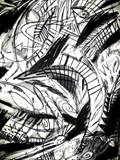 John Kochansky died last fall, suddenly and in his grown prime.
John and I were good friends, and daily spoke and sought solace for life's twistings in our discussions and toyings with art and poetry for a time. Eventually we fell out of touch, but not out of favor with one another. When we met on a sudden moment, we'd share the green cheer of a Heinekin and go off on a tear about this or that moment in the omni-ball of perceptions that is the artist's life. Some years back, while we were apart, I wrote a remembrance of John, an old-fashioned chant to bring the man before my eyes and recall his qualities, an appreciation.
...draw down from some hidden realm the good ju-ju...
When I first met John, long ago among dusty aisles of books, he drew, rather than wrote, his name and number for me to get in touch with him, saying something to the effect of "Why not play with the boundaries of the known? With a letter you know what to expect. When is a "JK" unrecognizable? When does it move from the known to the unknown? What is that boundary?"
John and I collaborated on a cartoon too, Fido Diablo, Devildog. The character's tag line was "A dog cursed with the head of a man." Fido's Joycean adventures combined a dream-text with a set of blazingly varied panels of illustration. The day John stopped by my old home to crank the collaboration into fine-tuned reality, he left behind a totem item, a sunflower-headed Barbie, to connect our toils on a spirit plane and draw down from some hidden realm the good ju-ju into our winsome sport. In all the years that have separated that day from this, she has not failed in her mission.
A sliced strawberry or kiwi fruit halved could provide an hour's worth of conversation for that kind man without pause or fatigue. Unexhausted talk flowed from him as naturally as sleep follows prayer, as the saying has it.
He approached each canvas or projected scheme with a methodical incertitude, a patient abeyance of judgment that, in his case, came I think, from a deep dejection, developed by a too-long brooding over the pathological isolation all the arts in this nation must suffer under as long as it lack a sustaining tradition.
His buoyant manner and whirlwind of activities withheld from view some central simplicity, some nexus, some weighted center...
He told me once of a textile project of his to impose on a pattern of flowers the recurrent outline of a girl's face, as in Dali's illusionist works. To him it was the simple doubling of positive impulse and positive impulse,--- as he had once half-humorously described the troika of beer, yeast, and women, and told of how that supreme triad had stolen his fate from his own hands and consigned it to their fertile substances. But we can see in that faint flickering between slant petal and female smile on the pillow, as between ant and saint in Dali, a shift in our perceptual paradigm. First the lovely girl, then all is exuberant blossom swirled with shadow. Looking again, petal and face have again exchanged their places. The sovereignty of the imagination to designate its objects is coaxed by a trick of the light, a suavity of line. Caravaggio, in his canvas of the conversion, has the stunned man crawling away amazed from the glossy side of a rioting horse, having seen, in some moment that mixed ecstasy and grace, some portion of God's countenance in that great glistening square of skin rearing in triumph over his lapsed and piteous body. But what besides that fallen saint's imagination had put it there? A shift in his ideas of the universe's central theme allowed him to see some discrete omnipresence in that reality which was before fit for nothing save the carrot or the spur. It is for this reason that my friend, when too full of the world and the world's affairs, clambers at dawn onto a limber trampoline to shake some new mystery down; and it is why, however troubled the life, the consummate artist must, like the straight wake of the turbulent swan, leave no unperfected image after him.
But I must see him, even now, half in the air, and smiling still, squabbling with me over some point of medieval church decoration or peasant folktale, and tossing a squeaking ball back to the madly circling dog.
"In this drawing of an apostle's nirvana
I gave a charming native girl christ's
fivefold power hand, a santa rea item.
The bone dice of fate are chiseled on her skin,
her breasts are docile rounds to those twinned squares,
her pubic matt preadolescently slim. Note
the use of black, another power totem,
which oil slicks in India ink the right or damned
hand side of the visual field; out of its night soils
burst pumpkins, and watermelons halved
for the easy licks of the naked girl who lies
with crossed arms at their side. Calabeza bianco
says the stylized head joined to the anointed
torso which hovers clubfooted in this dream
which I fancy St. Jerome on an off day may have painted."


   Gregg Glory
  [Gregg G. Brown]
1/6/2006
Gregglory.com has been updated with MP3s of over a dozen poems. Also included are sniggering outtakes from the studio session for the next CD Waxy Caskets. The first CD, Platinum Lips, will be ripped into MP3s and placed on the site over the next month or so.
1/3/2006
 Brandi Scollins-Mantha's Novel, Floaters, is ready to start the submission process to iUniverse.
As a micro-publisher, BLAST PRESS has neither the capacity nor the need to house several hundred
copies of a massive manuscript. We specialize in small-run chapbooks of poetry, essays, and novellas.
Brandi Scollins-Mantha's Novel, Floaters, is ready to start the submission process to iUniverse.
As a micro-publisher, BLAST PRESS has neither the capacity nor the need to house several hundred
copies of a massive manuscript. We specialize in small-run chapbooks of poetry, essays, and novellas.
By using iUniverse for our more ambitious projects, we get all of the advantages of a big print-on-demand publishing house, while still staying true to our authors. The entire cost is under-written by BLAST PRESS, so even though iUniverse advertises itself as a self-publishing option for authors, it becomes a useful printer's resource for BLAST PRESS. The manuscript is issued an ISBN, and is maintained as available-to-order on the web.
BLAST PRESS sets up an iUniverse account in the author's name, and manages the initial set-up, look and printer/publisher communications and edits for the author.
Once the book is printed, BLAST PRESS turns the account over to the author
This set-up allows BLAST PRESS to take on novels and other full-size book projects at minimal cost, while maximizing the benefits to the author.
1/3/2006